- Moved house, and ARC - Mt. Beacon ARC
- Got very busy with Family
- Actually helped teach a Tech class just like the one I took at HOSARC! (4 new HAMS! )
Monday, November 30, 2015
What's New?
Since my last post I have:


Sunday, October 21, 2012
HamRadioNow Special Edition - Steve Mendelsohn W2ML
Video of the last interview of Steve Mendelsohn W2ML
The Hall of Science Amateur Radio Club was privileged to have Steve Mendelsohn give a very informative talk at one of meetings just a few short years ago. He spoke about his experience with the Jets and Patriots controversy and some of his history in amateur radio. It was my first time meeting Steve, a very kind of man who was very generous with his time and experience. He was a leader in our shared hobby and someone we can look to as a example. We are all richer for having met him.
Special thanks to John Ronan K3AJJ, Jim McCarthy K6BBA, Gary Pearce KN4AQ, Bill Pasternack WA6ITF for all their work on this video.
Tuesday, July 3, 2012
Field Day 2012
This year I was only available to help with some of the setup for the HOSARC field day. The guys had worked out a network of diapoles and end fed wires that covered UHF, VHF,& HF. I got a few contacts on 15 meters and we even had a visitor from out of town who came by to operate.

Sunday, November 27, 2011
ARRL visual website tour video
For the November meeting of my amateur radio club, we had Katie Glass, KB1ULQ, the Digital Content Manager for the ARRL give a visual tour of the new ARRL website. This tour included some of the new features of the ARRL website such as social media components and popular older content like accessing the extensive ARRL archives and product reviews. Katie was a complete professional, taking questions from the audience and giving a thorough presentation. Attached is a video I made of the presentation.
Wednesday, November 9, 2011
Amateur Radio on the International Space Station
This is the Amateur Radio on the International Space Station (ARISS) presentation by Mark Steiner, K3MS. I recorded and edited this video for HOSARC my amateur radio club. The talk was given at the Hall of Science Amateur Radio Club general meeting in October of 2011. Mark touched on many different aspects of amateur radio on the ISS, including satellite launches, equipment on board the ISS, and ground stations. What did come out during the Q&A section of the talk was that if you would like to get some your own technology into space, design an easy system to change the Kenwood radio from school transmit mode to repeater mode easily via computer control. Seems the current process for changing the radio includes many more steps than busy astronauts have time for. If you can make it happen quickly, easily, and reliably, you could have your own tech in space! It is a high bar, but how many gear-heads do you know with systems they have designed in space. Please check out the video and leave comments. Full disclosure, the video does have pre & post-roll commercials. All money generated by these commercials will be donated entirety to the club. I hope you enjoy the video.
Thursday, October 20, 2011
30 minutes of APRS with Bob Bruninga, WB4APR
This is the first 30 minutes of Bob Bruninga, WB4APR giving a talk at my amateur radio club HOSARC. It was a very informative talk and I hope to get the rest of this talk in the near future. Bob's presentation was incredibly informative. If you ever get a chance to see him give a talk, run, do not walk. He is a tremendous resource to the amateur radio community.
Tuesday, September 6, 2011
Greene County still needs help after Hurricane Irene
Last night I spoke with Len Signoretti, N2LEN. He was tired but still working hard at the Greene County ARES deployment. He is still looking for volunteers and could use all the help he can get. If you have any time this week and are in the New York area, please contact him at: (phone number removed after event) It is a rural area and they have a 2M / 440 local repeater up running for main communications. If you have a good 2M / 440 mobile rig, you are most welcome. Please help out if you can.
Update 9/9/11:
Just spoke to Len this evening. The ARES activation for Greene County was deactivated Tuesday Sept. 6th followed by a one day ARES activation on Wednesday Sept. 7th for area flooding and to fill in for a cellular outage in the area. I called Len on and off during the week and that man was working so hard I doubt he even remembers talking to me. Hats off to everyone who volunteered for the relief effort. Len said he had people coming in from far and wide to help out.

Update 9/9/11:
Just spoke to Len this evening. The ARES activation for Greene County was deactivated Tuesday Sept. 6th followed by a one day ARES activation on Wednesday Sept. 7th for area flooding and to fill in for a cellular outage in the area. I called Len on and off during the week and that man was working so hard I doubt he even remembers talking to me. Hats off to everyone who volunteered for the relief effort. Len said he had people coming in from far and wide to help out.

Sunday, August 28, 2011
Queens ARES response for Huricane Irene
If you are a Queens New York based ham who would like to help ARES with the amateur radio response to Hurricane Irene, please contact Jeff Spiro via the following email address: N1JSP[at]arrl.net. Licensed Amateur Radio operators with HTs & Mobile Units welcome.
Best of luck to them in their efforts.

Friday, July 29, 2011
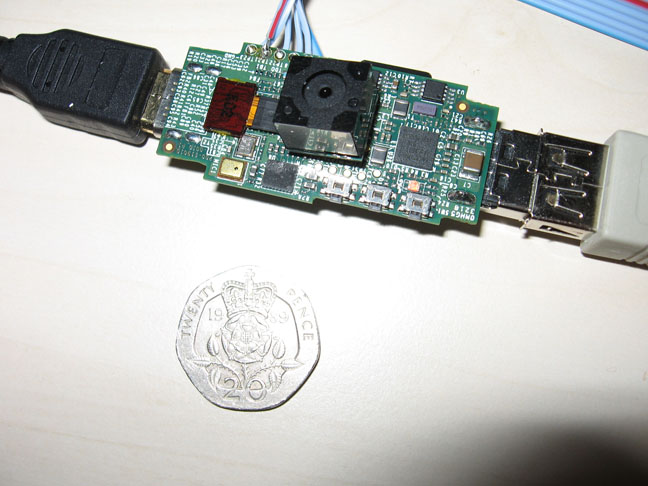
Raspberry PI, a $25 computer could be a great new platform for amateur radio
The Raspberry Pi Foundation has developed a $25 computer that is just made for hacking. This could be just the platform needed for inventive new APRS, and other amateur digital modes. Think of all the things you could do with the portable processing power of a 700MHz ARM11 processor coupled with 128MB of RAM hooked up to a HT or other portable. This device has been geared towards education so the documentation should be open and ready for hacking in the classic sense of the word.
One video port and one USB is all you get as far as ports for now, with both ethernet and Wifi planned. Power usage? 1W at full load. I have attached a video about it below. Update: They will also have a Model B with 256 megs of RAM and a 10/100 Ethernet port, price point: $35.

Update: Raspberry PI will be at the NYC Maker Faire. Looking forward to seeing what they have planned for the unit. Eben Upton, one of the founders will be there to explain the plans for the project.
We anticipate the device will be available to the general public later in 2011 – we were hoping to hit the end of November, but right now December’s looking more likely.
One video port and one USB is all you get as far as ports for now, with both ethernet and Wifi planned. Power usage? 1W at full load. I have attached a video about it below. Update: They will also have a Model B with 256 megs of RAM and a 10/100 Ethernet port, price point: $35.
Update: Raspberry PI will be at the NYC Maker Faire. Looking forward to seeing what they have planned for the unit. Eben Upton, one of the founders will be there to explain the plans for the project.
Update 2: On Availability: From the Raspberry PI website
When will the device be available to purchase?We anticipate the device will be available to the general public later in 2011 – we were hoping to hit the end of November, but right now December’s looking more likely.
Saturday, May 7, 2011
Bob Bruninga, WB4APR, (father of APRS) will be giving a talk @ HOSARC
On May 10th 2011 at 7:30pm HOSARC will host a very special meeting entitled "What you don't know about APRS" by Bob Bruninga, WB4APR, (father of APRS). Bob has been kind enough to give the meeting via teleconference and we are very much looking forward to learning from the master. I will be attempting to make a recording of the event with a screen-recording program, so there may be video.
UPDATE: HERE IS VIDEO OF THE FIRST 30 MINUTES OF THE TALK:
UPDATE: HERE IS VIDEO OF THE FIRST 30 MINUTES OF THE TALK:
Friday, February 11, 2011
A Practical Amateur Radio Podcast update!

Jerry , KD0BIK of the Practical Amateur Radio Podcast has released a new mini-episode detailing his future plans for the podcast. I am very happy to see this and look forward to what ever he produces. His podcast has been very helpful and makes for a good resource for anyone starting out in the hobby. Jerry is a good guy and I was especially touched by Jerry's effort to help everyone at HOSARC Save Our station back in 2008. While we lost our station in the end. It was very nice of him to drop everything and put out a emergency podcast at a moments notice. We need more guys like Jerry in our shared hobby. I for one would like to live up to his example. Good luck Jerry. I will be listening.
Monday, January 31, 2011
Amatuer Radio to the rescue of Protesters in Egypt.
No matter your stance on the student push for democracy in Egypt, it is very exciting to hear that they are using amateur radio and more specifically CW to get the word out on the protests. When all else fails, including the internet,... amateur radio.
Thursday, January 27, 2011
Amateur Radio Emergency Communications Enhancement Act of 2011
The H.R.81: Amateur Radio Emergency Communications Enhancement Act of 2011 is a bill in the House of Representatives... "To promote and encourage the valuable public service, disaster relief, and emergency communications provided on a volunteer basis by licensees of the Federal Communications Commission in the Amateur Radio Service, by undertaking a study of the uses of amateur radio for emergency and disaster relief communications, by identifying unnecessary or unreasonable impediments to the deployment of Amateur Radio emergency and disaster relief communications, and by making recommendations for relief of such unreasonable restrictions so as to expand the uses of amateur radio communications in Homeland Security planning and response." This is one long sentence that is great to read. If we can get this passed, it could be a huge help to our collective hobby, both nationally and internationally. If we can successfully integrate emergency services and amateur radio here in the US, it could greatly effect the way Amateur Radio is used in other countries. I look forward to seeing what becomes of this bill.
Saturday, December 4, 2010
Wednesday, September 22, 2010
HoSARC at the NYC Maker Faire Sept 25 & 26

The New York Hall of Science Amateur Radio Club will be running an exhibit on Satellite communications at the New York Maker Faire on Sept 25 & 26 2010. Our exhibit will cover Home Brew HF stations, our "Go Box" portable stations and live Satellite communications as propagation permits. There will be a special QSL card made just for the occasion and we are looking forward to spreading the word on Amateur Radio to like minded "Makers".
The Maker Faire has been around since 2006 and like its namesake the Make magazine it celebrates "arts, crafts, engineering, science projects and the Do-It-Yourself (DIY) mindset." These are all interests near and dear to any HAM's heart. If you have time this weekend, and you are in the New York area, please come on down. It promises to be quite a show.

Thursday, August 5, 2010
FieldDay 2010 Photos.
Here are a few pictures taken during the HoSARC 2010 ARRL Fieldday. We had a great time and made many contacts, amid the wind and the occasional pileups.
Saturday, June 26, 2010
Field Day 2010

73,
Patrick KC2RBE
Tuesday, May 18, 2010
Amateur Radio way to prove you are a human.

I was sending a web based E-mail comment about something on the TAPR website and noticed their clever method of "proving you are a human" to prevent spam. The likelihood of an web based CW skimming E-mail spambot is pretty slim, so this looks like a very secure amateur radio based feature for a website. I have always heard that the simplest solutions can be the best, and here is a great example. I am hoping to catch a east coast based DCC in the future as their cutting edge presentations look amazing. Understanding all of it is another story,
Tuesday, May 4, 2010
Making an animated RSS feed for QRZ & 73s page.
How to post your RSS feed on your qrz.com or 73s.org page:

Have you ever wanted to keep your qrz.com or 73s.org pages updated with a dynamic widget showing the most recent entries from your blog? Then a RSS feed may be what you are looking for. This simple syndication tool is a very easy but powerful tool for making your website/blog content available in multiple places quickly. In the tradition of amateur radio Elmer-ing, I am writing this post to let you know how I am using this tool. You may find it helpful in your Ham related project also. With some simple copying and pasting, you too can have these automated tools helping you share you amateur radio experience.
Disclaimer:To be clear, I am not a web guru, and all advice here is offered as an example of what I have done and has no warranty either implied or otherwise. My goal is to share what I have learned in order to encourage more amateur radio blogging & twittering because the web is one of our best resources.
One of the easiest way to share your work in "Hamology", as Gordon West calls it, is to start with a blog with an automatically generated RSS feed. Any of the major blogging engines these days have this feature so that is not an issue. (List available at bottom of post) The RSS feed itself is a small XML document listing the titles and URLs of items on your blog in chronological order. Once you have found your RSS feed location, just start a Feedburner account and point it toward the file to take advantage of the options the service provides. The Feedburner help section covers this in much more detail.
What you can do with your feed:
Now that you have your RSS feed setup, you can start leveraging the power of Feedburner to help promote your blog on your qrz.com or 73s.org bio page. Click on the "Publicize" tab of your Feedburner account to find the option we are working with.
 Once you are in the "Publicize" tab, just click on "Headline Animator" and follow the instructions to create a animated headline like the one I have at the top of this post.
 In order to add the animated headline to my qrz and 73s pages, I selected "Other(just gimme the code)" and posted the resulting HTML code into the pages. In my case I unchecked the " Grab this link" check box from the resulting pop-up window for a cleaner look.

Below I have screen shots of the resulting widget additions to my qrz and 73s pages.
I hope you have found this post helpful.
Resulting 73s.org and qrz.com pages:

 List of free blog sites that offer RSS feeds:
Blogger
WordPress
LiveJournal
In the next post, I will cover automatically adding your blog content to your Twitter page. Please share your ideas/corrections in the comments section.
Have you ever wanted to keep your qrz.com or 73s.org pages updated with a dynamic widget showing the most recent entries from your blog? Then a RSS feed may be what you are looking for. This simple syndication tool is a very easy but powerful tool for making your website/blog content available in multiple places quickly. In the tradition of amateur radio Elmer-ing, I am writing this post to let you know how I am using this tool. You may find it helpful in your Ham related project also. With some simple copying and pasting, you too can have these automated tools helping you share you amateur radio experience.
Disclaimer:To be clear, I am not a web guru, and all advice here is offered as an example of what I have done and has no warranty either implied or otherwise. My goal is to share what I have learned in order to encourage more amateur radio blogging & twittering because the web is one of our best resources.
One of the easiest way to share your work in "Hamology", as Gordon West calls it, is to start with a blog with an automatically generated RSS feed. Any of the major blogging engines these days have this feature so that is not an issue. (List available at bottom of post) The RSS feed itself is a small XML document listing the titles and URLs of items on your blog in chronological order. Once you have found your RSS feed location, just start a Feedburner account and point it toward the file to take advantage of the options the service provides. The Feedburner help section covers this in much more detail.
What you can do with your feed:
Now that you have your RSS feed setup, you can start leveraging the power of Feedburner to help promote your blog on your qrz.com or 73s.org bio page. Click on the "Publicize" tab of your Feedburner account to find the option we are working with.
 Once you are in the "Publicize" tab, just click on "Headline Animator" and follow the instructions to create a animated headline like the one I have at the top of this post.
 In order to add the animated headline to my qrz and 73s pages, I selected "Other(just gimme the code)" and posted the resulting HTML code into the pages. In my case I unchecked the " Grab this link" check box from the resulting pop-up window for a cleaner look.
Below I have screen shots of the resulting widget additions to my qrz and 73s pages.
I hope you have found this post helpful.
Resulting 73s.org and qrz.com pages:


Blogger
WordPress
LiveJournal
In the next post, I will cover automatically adding your blog content to your Twitter page. Please share your ideas/corrections in the comments section.
Friday, April 9, 2010
Ham Radio has been "Slashdotted"
Slashdot is a website I have been reading for years and I was very happy to see it running a story of the NPR report on the changing population of amateur radio operators. This brings together two of my favorite things, nerdom and news. After seeing report after report over the years about the future disappearance of amateur radio, comparing our hobby to a finite product like VHS or 8 track tape, it is so refreshing to see a report about the progress we are making in building our numbers. It is very easy to gloss over the "antiquated hobby" of amateur radio. But when you learn that people are using Morse code and digital modes on their own transceivers built into Altoids cases transmitting across the globe on just 5 watts of power, or working with the military on open source Software defined radio platforms, the argument of amateur radio as a dying hobby does not hold water. This hobby of ours has so much to offer people from all walks of life. Just last month we added a few more people to the ranks of the Hall of Science Amateur Radio Club or HoSARC. I have a feeling we will look back on these days as the start of a new era of amateur radio. I can not wait to see what is next for our hobby.
Subscribe to:
Posts (Atom)